Ranga B · 3 June 2026
Acintya lord, understood by children
In Bhakti Sangam, the infinite acintya Lord was explained by children—where their simple words carried transcendence, as if He chose it so
Share
This article
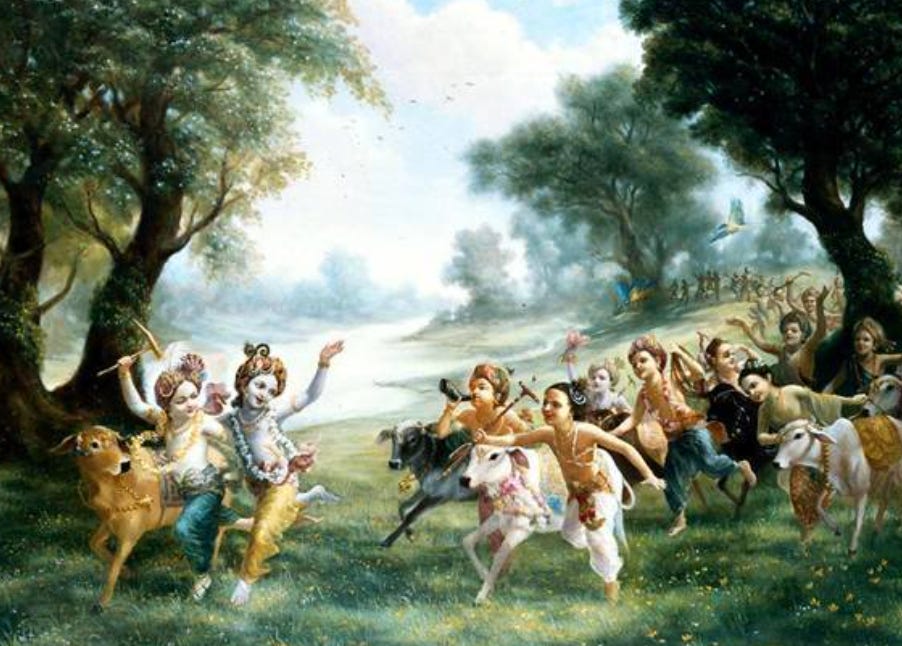
In Bhakti Sangam, and during lectures many times Krishna comes in the form of children. Many times he is chasing toys, making smiling faces, other times he is eating strawberries and saying childlike words that we dont understand. He climbs up and down the chairs sideways. He asks to be lifted when he needs
Krishna is crawling, sneaking out, jumping, eating, playing - all of it at the same time.
This is a passtime, transcendental
It is Shri Krishna in all the children. The antaryami krishna.
And all the children are part of Shri Krishna.
The children chose to play here in the background of bhagavatam, and such play becomes transcendental. Krishna is in the center of the fun When krishna is in the team, in the play, the joy has no bounds. The noise is meant to disturb and awaken the jivas, Its natural
I want to bring focus to a beautiful point here:
On perfect devotees who are yet children
The Lord always has affection for Children
The Bhāgavatam does not present child devotees as exceptions. It presents them as the standard—as purity of bhāva, undiluted by ambition or ritual pride, is precisely what the Lord cannot resist.
Dhruva Mahārāja was five years old when he walked into the forest to find God. Not the God of his teachers—but the God he would see with his own eyes. His tapasyā shook the cosmos. But the Lord did not come because of the tapasyā. He came because the yearning was pure and unconditional. When Viṣṇu appeared, every prayer Dhruva had rehearsed dissolved. He had come for a kingdom. He found something he could not name. His own words:
kācaṁ vicinvann api divya-ratnaṁ svāminn kṛtārtho ‘smi varaṁ na yāce (SB 4.9.14)
“I was searching for glass and I found the most precious jewel. I am complete. I ask for nothing.”
That completeness—kṛtārthaḥ—is the Vaiṣṇava threshold. The moment a soul stops expecting anything from the Lord, the Lord gives everything.
Prahlāda Mahārāja never wanted any favours. Born into a dynasty of Asuras, yet he soaked in devotion before birth through Nārada’s words in his mother’s womb, he emerged into the world already arrived.
Thrown into fire, hurled from cliffs, attacked by elephants—he chanted, and smiled, and felt sorry for his father. When Hiraṇyakaśipu roared “Is He in this pillar?”, Prahlāda did not argue philosophy. He simply said: Yes. The pillar broke. Nṛsiṁha roared. Worlds trembled. And the boy asked for nothing for himself—only this:
naivodvije para duratyaya-vaitaraṇyās tvad-vīrya-gāyana-mahāmṛta-magna-cittaḥ śoce tato vimukha-cetasa indriyārtha- māyā-sukhāya bharam udvahato vimūḍhān (SB 7.9.43)
“I do not fear suffering—my mind drowns in the nectar of Your glories. I grieve only for those turned away from You, carrying the crushing weight of sense pleasure.”
This is the Vaiṣṇava concept: the one in the most danger felt the safest. Because the lord is always holding hands. The one with the most virtue asked for the least. Prahlāda’s bhāva is exceptional
Narasimha himself says “There will be no devotee like prahlad ever”
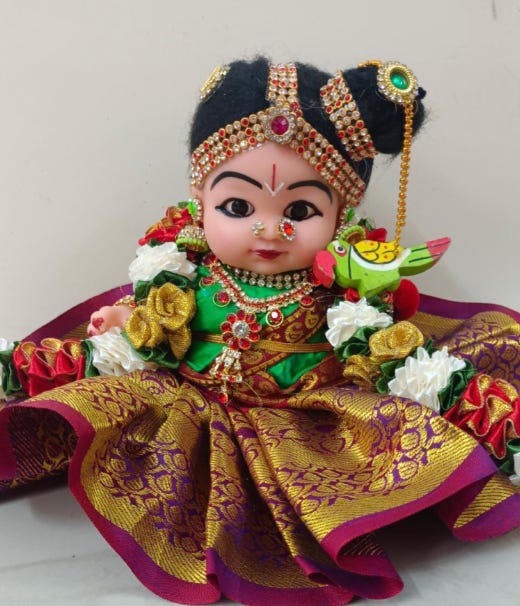
Śrīmatī Āṇḍāḷ — The child who’s pre-worn garlands were deeply sought by the Lord
Periyāzhvār peṟṟedutha peṇmaṇi avar vāzhiye — Glory to the jewel of a daughter received by Periyāzhvār
In Śrīvilliputtūr, Viṣṇucitta—Periyāzhvār—found a baby girl nestled in the earth of a garden, in similar way to how mother sita was found. He named her Kōḍhai and raised her in unbroken devotion. In reality she was incarnation of Bhoomadevi who is eternally with Sriman Narayana.
Every day, before the garland reached the deity, Kōḍhai would wear it first—breathing her love into every flower. When Periyāzhvār discovered this, he was horrified. A garland touched by a small girl, offered to the Lord? He immediately scolded the small girl his daughter
He began making fresh ones. But this time and many times when he tried the garlands would fall of the deity of the Lord. The lord did not accept the new garlands.
Meanwhile the Lord appeared to Periyāzhvār in a dream and said: I refuse the new garlands. Give Me only hers. The Lord who is worshipped by the four Vedas, who is served by Lakṣmī herself—that Lord rejected the ritually pure garland and asked only for the one worn by a child in love. A parallel can also be drawn here to how Sri Ramachandra adored the ber fruits given by most beautiful mother shabari after she had half bitten them to choose the sweetest fruits
Kōḍhai became Āṇḍāḷ— the meaning of the word is “She Who Ruled the Lord”
In her Tiruppāvai she calls out at dawn:
mārgazhi thiṅgaḷ mathi nirainda nannāḷāl nīrāda pōduvīr pōduminō nērizhaiyīr
“On this full-moon day of Mārgazhi, O beautiful ones—come, let us seek Him.”
No credentials. No ritual preparation. Just: come. And the promise she seals it with:
nārāyaṇaṉe namakke paṟai taruvan (Pāsuram 29)
“Nārāyaṇa Himself will give us liberation.” Not a ritual as gateway. The Lord Himself, directly, to us—because bhāva has its own access.
Bhagavān Cares for Bhāva
Dhruva had no lineage of sādhus. Prahlāda had a demon for a father. Āṇḍāḷ broke protocol and wore the Lord’s own garland before He did. The Bhāgavatam does not hide these facts—it celebrates them, because they establish one irrefutable Vaiṣṇava siddhānta:
The Lord is not bound by our qualifications. He is bound by our love.
He is Bhaktavatsala—the one who is helplessly drawn to His devotee’s bhāva. You cannot earn Him. You cannot impress Him. But you can love Him—and that, He will never refuse.
Offer Him your bhāva. He is eternally yours.
Jai Śrī Rādhā Mādhava
Share
This article