Ranga B · 28 April 2026
The transcendental beauty of Shri Nṛsimha Katha: with Gaudiya, Sri vaishnava, Madhva perspectives
All glories to Shri Hari! All Glories to Srila Prabhupad !
Share
This article
Ito Nṛsiṁha, Parato Nṛsiṁha
Yato Yato Yāmi, Tato Nṛsiṁha
Bahir Nṛsiṁha, Hṛdaye Nṛsiṁha
Nṛsiṁham ādim śaraṇam prapadye
Nṛsiṁha is here, Nṛsiṁha is there.
Wherever I go, there is Nṛsiṁha.
Nṛsiṁha is outside, Nṛsiṁha is in the heart.
I surrender and offer my obeisances to the supreme lord Nṛsiṁha
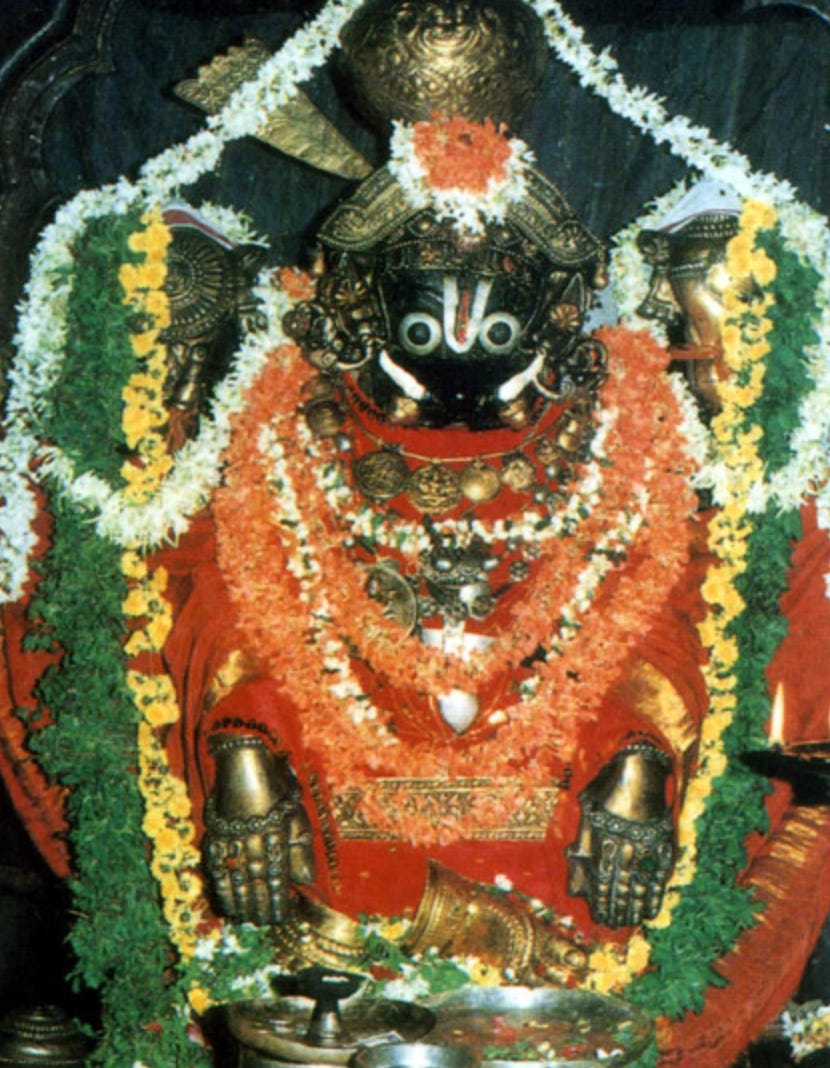
A demon king denies God.
A child declares God is everywhere.
A pillar is struck.
God shows up for the devotee.
Nṛsiṁha: The Lord Who Appeared—Immediately
That all-pervading presence of God is not merely declared—it is revealed most strikingly in one defining moment:
Prologue:
In every age, there arises a demon Hiraṇyakaśipu—an archetype of defiant ego, intoxicated by power and imagined invincibility. Yet such apparent dominance fails; it is always subordinate to the supreme Lord and his promise to His devotee.
That devotee was Prahlāda— unwaveringly focussed on the lotus feet of Śrī Hari, Śrīman Nārāyaṇa.
The confrontation was inevitable. Hiraṇyakaśipu demanded:
“Where is your God? If He is everywhere, show Him in this pillar.”
kvāsau yadi sa sarvatra, kasmāt stambhe na dṛśyate
Hiranyakasipu struck the pillar.
What followed was not philosophy, but direct demonstration.
To uphold the truth of His devotee’s word, the Supreme Lord appeared as Śrī Nṛsiṁha—right there , from the pillar—instant, unmistakable, and beyond comprehension.
satyaṁ vidhātuṁ nija-bhṛtya-bhāṣitaṁ
vyāptiṁ ca bhūteṣv akhileṣu cātmanaḥ
adṛśyatātyadbhuta-rūpam udvahan
stambhe sabhāyāṁ na mṛgaṁ na mānuṣam( Universal, SB Srimad bhagvatam 7.8.17)
Then what happened:
And just as the appearance was beyond expectation, so too was its conclusion beyond comparison.
tava kara-kamala-vare nakham adbhuta-śṛńgaḿ, dalita-hiraṇyakaśipu-tanu-bhṛńgam
keśava dhṛta-narahari-rūpa jaya jagadīśa hare
The rest is well known. It was not even a contest.. Hiranyakashipu was delivered in fractions of nanoseconds. Lord Nṛsimha crushed demon hiranyakashipu like a wasp in his pointed lotus like nails, and the Lord brought the world back to order.
I will describe the most magnificent Lord Nṛsimha and the spectacular events of His appearance in more detail later in this article, but the key takeaway is: The compassionate lord appeared instantly, for only one devotee
That accessibility is given in a direct form as His holy name—where the Lord is present without distance or delay. FF
Hari naam, the holy name of Lord
We start with exploring gaudiya vaishnava sampradaya, with teachings of Caitanya Mahāprabhu who is swayam shri Krishna. Shri Caitanya Mahaprabhu has made it unambigous that chanting the holy name is most important !
harer nāma harer nāma harer nāmaiva kevalam
kalau nāsty eva nāsty eva nāsty eva gatir anyathā
He says in this age of Kali, there is no other way, no other way, no other way—only the holy name of Hari.
[Śrī Vaiṣṇava] One of the most beautiful expressions of Shri Hari’s holy name is from the saint Kambha, which he mentions in the Narasimha subepic (Iraniyan Vadhai Padalam), within his Kambha Ramayana. You will be surprised Kambha ramayana is like a mini bhagavatam within Ramayana as Kamba describes all avatars of Narayana/Krishna
Kulandharum selvam thandhidum
Adiyaar paduththuyir aayiram ellaam
Nilandharam seyyum nezhvi sembarulum
Arulodu perunilam alikkum
Valandharum matrum thandhidum
Petra thaayum aayum seyyum
Nalam tharum sollai naan kandu konden
Naarayanaa ennum naamam
“This grants noble lineage, immeasurable true wealth; Removes countless sufferings and afflictions of devotees; This sustains the earth and with pure auspicious grace; With grace also bestows vaikunta; Grants spiritual growth and even more benefits, nourishes us with mother-like care, giving all transcendental auspicious wellbeing, I have found the word of true transcedental blessing, It is the holyname of Shri hari ‘Narayana’ “, so states Prahlad mahraj
The holy name of Śrī Hari is not only seen in terms of the auspiciousness it grants; rather, one is led to what it is—the very foundational truth upon which all existence rests.
[Śrī Vaiṣṇava] “Thōṟṟam ennum aththol vinai thodu kadal, suzhi ninṟu ēṟṟu nan kalan, arungkalan yāvarkkum, iniyamāṟṟa mangalam, māthavar vēdaththin varaṃbin thēṟṟa meypporuḷ, thirundha maṟṟu idhin illai, siṟandha”
From the whirlpool of the ocean of birth and existence, Narayana (harinaam) is the strong and precious ship that helps all beings cross safely, the auspicious refuge for everyone, and the true essence of the Vedas known by great sages. There is nothing more pure, perfect, or superior than this truth, which alone is established as the highest reality.
For to His devotee, He is not distant, but deeply deeply personal.
Nrsimha : The Dearest-Dear Lord (Double Emphasis)
In Vaiṣṇava sampradāya, the usage of “namma / nam” (“ours”) is not casual but doctrinal. [Sri vaishnava] Nammāḻvār repeatedly employs terms such as nam perumāḷ and nam kaṇṇan to express the lived reality of the jīva’s relationship with the Lord—not as separation, but as belonging.
This expression is further intensified with a double-emphasis used Tirumaṅgai Āḻvār [Sri vaishnava], who refers to Lord Nṛsiṁha as “nammudaiya nam-perumāḷ.” This is not only drive the point harder but reveals a transcendental relation . Nammudaiya establishes possession (“the Lord who belongs to us”), while nam-perumāḷ reaffirms the Lord as “our Lord.” Together, they are deliberate: first establishing sambandha, then expressing realized intimacy.
Thus, the phrase is not ornamental—it is layered revelation:
The Lord who belongs to us, and who is experienced as ours. This also can be said as “Dearest Dear Lord” with double emphasis . [Sri vaishnava]
In the case of Nṛsiṁha, this is not abstract. The Lord does not remain in transcendence nor act through a mediated avatāra process—He manifests immediately, in direct response to the devotee. This immediacy alone justifies the intensified expression.
It is this that leads into the next doctrinal point.
Acintya: Truly Infinite and Inconceivable
The Vaiṣṇava understanding begins with a fundamental paradox: the Supreme Lord cannot be contained within the limits of human reasoning, and yet He is fully accessible to devotion. He is simultaneously beyond comprehension and personally revealed.
This is the essence of Acintya-tattva.
Nṛsiṁha (Krishna) is thus understood as the Supreme Personality of Godhead—Sākṣāt Bhagavān—in whom apparently opposing qualities coexist without contradiction:
He is sarvavyāpī (all-pervading) and aprameya (immeasurable), yet appears within a finite pillar as stambha-vāsah.
He is acintya (inconceivable), yet directly perceived by the devotee as Bhagavān.
He is saumya (gentle to devotees) and raudra (terrifying to the demoniac).
He is stira (unchanging) and yet dynamically responsive in protection of His devotee.
He is karuṇa (merciful) and yet ugra (fierce in protection).
He is nirākāra (beyond material form), and yet manifests as the fully personal Nṛsiṁha-rūpa.
He is akāla (beyond time), yet appears within sandhyā-kāla.
He is avyakta (unmanifest), yet becomes fully vyakta (manifest).
Lets proceed further as this gets even more beautiful
Cetanā (conscious/living) - this refers to all living beings
Acetanā —-> Non living/material.
Generally life comes from life (cetanā—>cetanām)
By appearing from a pillar Narasimha shows he’s beyond material/creation, as supreme personality of godhead (Krishna). In fact its fondly said that vasihnava acharya’s referred to the pillar as Brahmaji’s grand mother (even affectionately called as Sthambini).
In their view the whole universe, every atom molecule is impregnated with Nrsimha (Krishna) yet same time he is outside the creation unaffected, this is the beautiful acintya. [Sri vaishnava]
Thus, the universe is within Narasimha, yet He is not contained by it.
This is the essence of acintya.The same truth is hinted when Mother Yaśodā sees the entire universe within the mouth of child Kṛṣṇa and faints—unable to reconcile the Infinite within the finite.
Śāstric pramāṇa (why this is fact not sentiment)
Cause of All Causes
[Śrī Vaiṣṇava] Viththu indri viḷaivadhu onru illai; vēndē! nin piththu indri uṇarndhiyēl, aḷavai peyguven; ‘uyththu onrum ozhivu indri uṇarthal pātru’ enaa kai-thu onru nelli am kaniyin kāṇdiyāl.
Nothing exists without a cause; if you truly understand without confusion, I can —just as a small gooseberry seed proves a whole tree, truth is revealed from a subtle cause. Narayana is the supreme personality and cause of all causes!
Truly Infinite and Acintya
[Śrī Vaiṣṇava] Thannulē ulagam eṉaivum thandhu, avai thannul ninru, thaan avatrul thanguvaan; pin illan, mun illan, oruvan; pērgilan; thol nilai oruvarāl thuniyarpādo?
Krishna (Narayana) contains all worlds within Himself and exists within them; He has no beginning or end, cannot be fully named or limited, and cannot be grasped by ordinary reasoning (acintya)
Prahlada says this even more beautifully about acintya aspect
[Śrī Vaiṣṇava] “Kaṇṇinum karandhuḷan; kaṇḍu kāṭṭuvār uḷ niṟaindhidum uṇarvu āgi, uṇmaiyāl, maṇṇinum, vāṉinum, maṟṟai mūndrinum eṇṇinum nediyavan oruvan, eṇ ilān”
Narayana is present even though He is not easily seen, and He remains hidden from ordinary vision; yet He is the very inner awareness that becomes fully present in the minds of those who truly seek and perceive Him. In reality, He pervades the earth, the heavens, and all other realms beyond them, filling everything completely. He is infinitely vast, extending beyond all imagination, measurement, or calculation. Though everything exists within Him, He Himself cannot be limited, counted, or fully comprehended by any means.
Source of all strengths in Everyone/Everything
Lets zoom into Bhagavatam now where Prahlāda Mahārāja makes this truth clear when addressing Hiraṇyakaśipu. Even the very strength by which the demon king challenges the universe is not his own—it is borrowed from the same Supreme Lord who empowers all beings.
na kevalaṁ me bhavataś ca rājan
sa vai balaṁ balināṁ cāpareṣām
pare ’vare ’mī sthira-jaṅgamā ye
brahmādayo yena vaśaṁ praṇītāḥ [Universal, SB 7.8.7]
Prahlād clearly tells Hiranyakasipu “He is not only your strength or mine, but the only strength for everyone. Without Him, no one can get any strength. Whether moving or not moving, superior or inferior, everyone, including Lord Brahmā, is controlled by the strength of the Supreme Personality of Godhead”
Infinite and acintya
[Śrī Vaiṣṇava, Kamba] Aḷavaiyān aḷappa aridhu; arivin appuṛaththu uḷa; aiyā! upaniṭathangaḷ ōdu; kiḷavi ār poruḷgalaal kiḷakkuṟādhavan kalavai yār ariguvār? meymmai kaṇdilar.
Narasimha (Narayana) is beyond measurement and intellect; even the Upanishads describe Him, but those who lack true vision cannot fully understand His reality.
Supremely poweful, Supreme personality of god
In the sacred place of Ahobilam, where the Lord manifested as Nṛsiṁha, the sthala-purāṇa captures the awe and wonder of His appearance in a single, powerful expression of devotion:
[Universal] Aho Veeryam ….Aho Souryam AhoBahu parakramah……
Naarasimham Param Daivam Ahobilam Aho Balam
The very place of His manifestation resounds with astonishment—marveling at His incomparable valor, supreme courage, and limitless strength. It proclaims that this Nrsiṁha is none other than the supreme personality of godhead (Krishna) himself.
The Stambha āvirbhāva stotra further glorifies this awe-inspiring form of the Lord, emphasizing his transcendental glory:
[Mādhva] apūrva śaurya dhairya vīrya durnivārya durgamam, agarva sarvanirvahatsuparvavarya parviṇam | (Stamba avirbhava Nrsimha stotra)
= Whose courage, patience, and power are unparalleled, irresistible, and invincible. Who bears all burdens without pride, and is supreme among the greatest.
The revered Madhva Vaiṣṇava ācārya, Vijayīndra Tīrtha, also describes Nṛsiṁha (Krishna) in a deeply affectionate way, revealing Nṛsiṁha (Krishna’s) universal form as the foundation of all existence:
[Mādhva] pādadvandvaṁ dharitrīkatipivulataraṁ merumadhyūrdhvamūrum. nābhiṁ brahmāṇḍasindhuṁ hṛdayamapi bhavō bhūtavidvatsamētam
His two feet support the earth; His thighs rise like Mount Meru.
His navel is the cosmic ocean; His heart contains existence and all beings.His arms bear marks of power; His nails like thunderbolts; eyes like moon, sun, and fire.His face blazing like fire, victorious over the gods’ enemies—
These verses spell it our clearly: Nrsimha, hey govinda, is supreme lord, the very support and protector of all cosmic creation.
Revelations from Lord Brahma
Even Brahmā’s role as creator is not independent of Him:
[Sri Vaishnava] Thannai padaiththadhum thāne enum thanmai pinnai padaiththadhuvē kāttum; perum perumai unnai padaiththāy nee endral, uyir padaippān ennai padaiththāy nee enum idhuvum eththu āmo?
Brahma’s says his own role as the originator of living beings is not independent—it exists only because Narayana has willed it. This removes any sense of separate authorship in creation.
[Sri Vaishnava] Pal āyira kōṭi aṇḍam pani kaḍalul nillātha mokkul ena thōnrumāl, ninnuzhaiyē; ellā uruvamum āy nindra kāl, iv uruvam vallē padaiththāl, varambu inmai vāradho?
Brahma says to Narasimha directly “Countless thousands of crores of universes arise within You like fragile bubbles upon the cool ocean—appearing for a moment, only to vanish without a trace. All forms are but Your own, for You stand as the essence of everything that is. And if You can will even a single form into being, does it not proclaim Your boundless nature?”
Further Convergence of Truth
Across all Vaiṣṇava sampradāyas, the same truth is revealed through different śabda-pramāṇa. Nṛsiṁha is described as:Nṛsiṁha is:
amitaguṇagaṇaṁ — infinite qualities (Mādhva)
pin illan, mun illan — without beginning or end (Śrī Vaiṣṇava)
aḷavaiyān aḷappa aridhu — beyond measurement, immeasurable (Śrī Vaiṣṇava)
arivin appuṛaththu uḷa — beyond the reach of intellect (Śrī Vaiṣṇava)
purushottama — the Supreme Being beyond all souls and matter (Universal)
Achyuta, Ananta, Govinda: the infallible, infinite, ever-protecting Lord
sarva-kāraṇa-kāraṇam — cause of all causes (Universal)
pratyēkarūpaṁ parapadanivāsaṁ — existing beyond material realm in the supreme abode (Mādhva)
svajana-jananutāḥ — worshipped and adored by His devotees (Mādhva)
dēvānām vipradānaṁ — giver of blessings, worshipped by all devas (Mādhva)
ōm iti dhyānatām — the ultimate meaning and object of Om (Mādhva)
Unambiguously stated thus
Thus all śāstra and ācārya statements converge into a single truth:
Nṛsiṁha is the source of all existence,
the cause of all causes,
the support of all worlds,
and yet beyond all grasp of thought or measure.He is simultaneously within everything and beyond everything—
immanent in all, yet untouched by all..
Having established his supremacy through śakti and acintya tattva, the narative does not conclude in abstraction, but moves toward a more intimate revelation—where the same Supreme Lord is experienced not only as all-powerful, but as supremely beautiful in his relationship with the devotee.
Bhakta Anubhava: Nrsimha as “Most beautiful”
Vaiṣṇava Ācāryas often describe Śrī Rāmacandra as Sundara Rāma, the embodiment of serene and composed beauty. In the Rāmāyaṇa and traditional stotras, He is praised as rūpa-sampannaḥ (perfect in form), priya-darśanaḥ (pleasing to behold), śyāmaḥ (enchanting dark hue), and komala-aṅgaḥ (soft and graceful-limbed). He is also remembered as śāntakāra—the very embodiment of calmness—and manohara, the one who effortlessly captivates the heart.
Yet, most strikingly, it is for Śrī Nṛsiṁha Bhagavān that vasihnavas reserve an even more profound expression of beauty—Azhagiya Siṅghar—transcendental beauty not only in form but most beautiful compassion, unmatched.
Azhagiya = Beautiful
Singham = Transcendal form of Narahari
Azhagiya Siṅghar = “The Beautiful Divine Lion”..
For Vaiṣṇavas, Lord’s Nṛsiṁha beauty is expressed when his aiśvarya (magificent potential) blends with Vatsalya (parental affection) and saulabhya (approachability) for the devotee.
Nṛsiṁha is uniquely beautiful because:
He breaks all boundaries (material, time, rules, form) just to help devotee
He holds simultaneous padaoxes—ugra yet dayālu (compassionate)
His form is not for self-display, but entirely for protection of the devotee
Thus, His beauty is spectacular —it is deeply relational.
This is why the tradition calls Him Azhagiya Siṅghar: His beauty is revealed in His response. He is beautiful because He came.
Deeper Bhakti-Insight :Vaiṣṇavas therefore express absolute surrender in this awareness:
[Sri Vaishnava] tvayi rakṣati rakṣakaiḥ kim anyaiḥ
tvayi cārakṣati rakṣakaiḥ kim anyaiḥ
iti niścita-dhīḥ śrayāmi nityaṁ
nṛhare vegavatī-taṭāśrayaṁ tvām
Dearest Dear lord Narasimha: If You protect, what need is there for any other protector? If You do not protect, what use are other protectors?
With this firm conviction, I always surrender to You,
O Narasimha who dwells on the banks of Vegavatī.
Even what appears as his ugra form is his controlled manifestation of infinite auspiciousness and beauty. To fully appreciate this, one must again return to the perspective of Hiraṇyakaśipu, whose apparent strength and certainty reveal the limits of material reasoning.
Stand in awe: The Divine appearance of shri Narasimha
The Collapse of Illusion
Evil assumes permanence and calls it invincibility. Hiraṇyakaśipu’s protection was framed as total: neither inside nor outside, neither day nor night, neither man, beast, nor weapon could harm him.
But in Vaiṣṇava darśana, such “completeness” is not perfection—it is ignorance structured as certainty.From this standpoint, the Lord’s appearance is not merely dramatic, but revelatory: illusion does not resist truth; it dissolves in its presence.
The Pillar Breaks
[Sri Vaishnava] Kamba most excitedly recites “ Pilanthathu thūṇum; āngē piranthathu, sīyam; pinnai vaḷarnthathu, thisaikaḷ ettum; pagirāṇdam mudhal aṉḍam alandathu; appuṟaththu seygai yār aṟinthu aṟaiyagirpār? kiḷarnthathu; gagana muttai kizhindhathu, keezhum mēlum.
The pillar was torn apart, and from it appeared the beautiful dhivya simham form of Lord narasimha . Then he expanded in all directions, filling the universe. Who can truly understand or describe its divine act? The cosmic egg itself split, filling both the heavens and the earth. How magnificient
Cosmic Intensity of Appearance
When Nrsimha appeared, just the divine thunderous sound of divine appearance of Lord, startled Hiranyakashipu, He was seeing it as if a million suns had descended on earth
sa sattvam enaṁ parito vipaśyan
stambhasya madhyād anunirjihānam
nāyaṁ mṛgo nāpi naro vicitram
aho kim etan nṛ-mṛgendra-rūpam. [Universal SB, Canto 7]
When Narasimha appeared, Vijeyendra Theertha explains in sodashahabahu narasimha ashtakam stotram
[ Mādhva] bhūkhaṇḍaṁ vāraṇāṇḍaṁ paravaraviraṭaṁ ḍampaḍampōruḍampam. dim ḍim ḍim ḍim ḍiḍimbam dahamapi dahamaiḥ jhampajhampaiśca jhampaiḥ. tulyāstulyāstu tulyāḥ dhumadhumadhumakaiḥ kuṅkumāṅkaiḥ kumāṅkaiḥ etat te pūrṇayuktam aharahakaraḥ pātu māṁ nārasiṁhaḥ
The earth, the cosmic creation, the vast and supreme expanse—resounding with pounding, crashing force. “ḍim ḍim” drums resound; burning, blazing—“jham jham”—with explosive, striking energy. Equal and unequal forces clash; “dhuma dhuma” smoke-like bursts, marked with red (auspicious) power.
He illustrated further Lords divine appearance
[Mādhva]enābhraṁ garjamānaṁ laghulaghumakarō bālacandrārkadaṁṣṭrō
hemāmbhojaṁ sarōjaṁ jaṭajaṭajaṭilō jāḍyamānastubhītiḥ dantānāṁ bādhamānāṁ khagaṭakhaṭakhaṭō bhōjajānuśsurendrō
Like a roaring cloud, swift-moving, with fangs like the young moon and sun.
Golden lotus-like form, matted locks shaking—remover of dullness and fear.
Teeth crushing enemies, with clashing sounds—lord even of the gods.
And in a very divine presence to devotees, the lord presented himself as follows
[Mādhva] śaṅkhaṁ cakraṁ ca cāpaṁ paraśumasiśaraṁ śūlapāśāṅkuśāstram. bibhrāṇaṁ vajrakeṭaṁ halamusala gadākuṇṭamatyugradamṣṭram jvālākēśaṁ trinētraṁ jvaladanalanibhaṁ hārakēyūrabhūṣam vandē pratyēkarūpaṁ parapadanivasaṁ pātu māṁ nārasiṁhaḥ
Holding conch, discus, bow, axe, sword, arrows, trident, noose, and goad. Also bearing thunderbolt, plough, mace, spear—with extremely fierce fangs. Flaming hair, three-eyed, shining like fire, adorned with ornaments. I bow to that unique form of Lord as Narasimha—may he always protect us.
About the same situation Kamba, says
[Sri Vaishnava] Āyiram koṭi veḷlathu ayil eyirttu avuṇarkku, angangē, ēyina oruvarukku oru oru thirumugam, irattip pon thōl, thī enak kanalum sen kaṇ siram thorum mūnḍrum, theyva vāyinil kadalgaḷ ēlum, malaigaḷum, matrum, muṟṟum.
In the battlefield filled with countless demons, the divine form manifested multiple faces, blazing eyes, and radiant arms. Oceans, mountains, and worlds were all present within that divine being.
Instant Collapse of Adharma
Srimad bhagvatam says “nadan nṛsiṁhaṁ prati daitya-kuñjaraḥ”; the Lord, appearing in the form of half lion and half man; prati — toward; daitya-kuñjaraḥ — Hiraṇyakaśipu, who was like an elephant.
Hiranyakashipu was instantly terrified, this is not what he expected!
I didn’t order this he says
It is a misconception that the battle took time, it was instantly over in nanoseconds even as it just started; It was a very unequal battle indeed
Srimad bhagvatam says hiranyakasipu was like a small insect, inconsequent
alakṣito ’gnau patitaḥ pataṅgamo
yathā nṛsiṁhaujasi so ’suras tadā
na tad vicitraṁ khalu sattva-dhāmani
sva-tejasā yo nu purāpibat tamaḥ. [Universal SB, Canto 7]Just as a small insect falls forcefully into a fire and the insignificant creature becomes invisible, when Hiraṇyakaśipu attacked the Lord, who was full of effulgence, Hiraṇyakaśipu became invisible. This is not at all astonishing, for the Lord is always situated in pure goodness
For a mere nanosecond Nrsimha playfully let Hiranyakasipu escape and the demon thought in that transient illusion he was indeed powerful,
sa tasya hastotkalitas tadāsuro
vikrīḍato yadvad ahir garutmataḥ
Lord Nṛsiṁhadeva gave Hiraṇyakaśipu a chance to slip from His hand, just as Garuḍa sometimes plays with a snake and lets it slip from his mouth
taṁ manyamāno nija-vīrya-śaṅkitaṁ
yad dhasta-mukto nṛhariṁ mahāsuraḥ
Srila prabhupad in purport says “When a sinful man enjoys material facilities, foolish people sometimes think, “How is it that this sinful man is enjoying whereas a pious man is suffering?” By the will of the Supreme, a sinful man is sometimes given the chance to enjoy the material world as if he were not under the clutches of material nature, just so that he may be fooled”
Anyways in a quick nano-second the battle was over; Narasimha destroyed the demon Hiranyakasipu
viṣvak sphurantaṁ grahaṇāturaṁ harir
vyālo yathākhuṁ kuliśākṣata-tvacam
dvāry ūrum āpatya dadāra līlayā
nakhair yathāhiṁ garuḍo mahā-viṣam. [Universal SB, Canto 7]
The Surgery of Grace
As Hiraṇyakaśipu moved his limbs here, there and all around, very much afflicted at being captured, Lord Nṛsiṁhadeva placed the demon on His lap, supporting him with His thighs, and in the doorway of the assembly hall the Lord very easily tore the demon to pieces with the nails of His hand.
Even in this overwhelming display of power, Vaiṣṇava siddhānta does not read it as destruction, but as karuṇā in action—the Lord removing adharma to re-establish dharma and protect the devotee.
Vaishnava Ācāryas therefore understand Nṛsiṁha’s appearance as that of a divine surgeon. Hiraṇyakaśipu is like a patient afflicted by deep inner disease, and the Lord places him upon His lap as upon a surgical table. His nails act like precise instruments/surgical scalpels, removing the root of adharma. Thats a surgeon at work saving the patient. Those hands are seeming with blood yet very pure .What appears as ugra is actually corrective mercy—absolute compassion acting.
Infact Hiranyakasipu was none other than from Jaya of Vaikunta’s gatekeeper and after the pastime he will go to Vaikunta
Shri Narasimha dev bhagwan ki jai!
Conclusion
The Supreme Lord is not distant or abstract; just as He appeared for Prahlāda, He is ever-present. He is present for you too!
Just seek like Prahalad did!
Takeaways
As direct proof, Shri Krishna (Narasimha) has appeared with all 6 opulences, showing he’s god, right then and there.
All vaishnava sampradayas concur he’s supreme personality of godhead
He is most beautiful because he came immediately
His nature is infinite, inconceivable, yet very personable to devotees
Nrsimha is uniquely called ”Dearest Dear Lord”.
He is the original wow, aho
Evil is temporary— Supreme Lord ensures dharma always wins
Sthala Puranas of Nrsimha temples are spectacular, awe-inspiring
Śāstric final thoughts
[Sri Vaishnava] Kāmam yāvaiyum taruvathum, ap patham kadanthāl, sema veedu uṟa seivathum, sen thazhal mukantha oma vēlvi yin uṟu patham uyyppathum, oruvan nāmam; annathu kēḷ: Namo Nārāyaṇāya!
The holy name of Narayana (krishna) grants all benefits, and when one transcends those desires, it leads to liberation and the eternal divine abode; it is the ultimate goal and result of sacred fire rituals performed with pure devotion, and all spiritual attainments are fulfilled through this one name alone—listen to this supreme truth: “Namo Narayanaya.”
In the words of Swami Vedanta Desika,
[Sri Vaishnava] tapanendv-agni-nayanaḥ tāpān apacinotu naḥ tāpanīya-rahasyānāṁ sāraḥ kāmāsikā-hariḥ
May Lord NaraHari of Kāmāsikā, whose eyes are like the sun, moon, and fire, remove our sufferings.He is the very essence of the secret teachings of the Upaniṣads.
Lets all take shelter of Lord Narasimha’s protection
Nṛsiṁha is not confined to a single avatāra-līlā of the past, but is an ever-present reality—He came then, He remains now. The only question is: will we call upon Him with sincerity?
Closing with Prayers to shri Narasimha
[Mādhva] kē kē nṛsiṁhāṣṭakē navarasarasaśrīṁ dēvabhītiṁ ghṛṇītā
dēvandyō vipradānaṁ prativacana parāyāyaṁ pratyānaiṣiḥWho would not revere this glorious Narasiṁha aṣṭaka, filled with the essence of the nine rasas and capable of removing fear?He is worthy of worship among the gods, the giver of boons to devotees, and the one who responds to prayers and fulfills them.
sāpaṁ cāpam ca khaḍgaṁ prahasitavadanam cakracakrākṛtēna
ōmiti dhyānatāṁ prakacavidhiṣu pātu māṁ nārasiṁhaḥHe holds weapons like the bow and sword, yet his face remains smiling and serene, and he wields the divine discus of protection.May Lord Narasiṁha, who is meditated upon through the sacred syllable “Om” in all rituals, protect me.
bhūtapretapiśācayakṣagaṇāṁ dēśāntarōccāṭanāt
cōravyādhi mahājvaram bhayaharaṁ śatrukṣayaṁ niścayamHe drives away ghosts, spirits, demons, and yakṣas from all places.He surely removes theft, disease, high fever, fear, and ensures the destruction of enemies.
sandhyākālē japataṁ sadbhaktipūrvakaṁ
prahlādēna varō varastu jayati satpujitaṁ bhūtayē pātu māṁ nārasiṁhaḥThose who chant this hymn at twilight with true devotion receive great blessings like Prahlāda. Through proper worship they attain victory and auspiciousness—may Lord Narasiṁha protect me always.
Narasimha dev bhagwan ki Jai!
[Disclaimer] This article shares insights from the Vaiṣṇava tradition of Sanātana Dharma (Hindu Religion) in a humble spirit of devotion and philosophical inquiry. It does not seek to criticise or compare with other religions, faiths, gurus or traditions, but to present only the understanding received through this vasihnava lineage.
Share
This article