Ranga B · 3 August 2026
Sri ji who is Namagiri (Lakshmi)
Tapta-kāñcana-gaurāṅgi rādhe vṛndāvaneśvari |
Share
This article
Tapta-kāñcana-gaurāṅgi rādhe vṛndāvaneśvari |
Vṛṣabhānu-sute devi praṇamāmi hari-priye ||
![Arulmigu Narasimaswamy Temple, Kottai Main Road, Namakkal Town - 637001, Namakkal District [TM004887].,1.Arulmgiu Namagiri Thayar temple, 2 Sylasethram 3 Sylamalai 4 Nagavanam 5 Namagiri,Arulmigu Narasimma swamy,Arulmigu Namagiri Thayar](https://substackcdn.com/image/fetch/$s_!aHa7!,f_auto,q_auto:good,fl_progressive:steep/https%3A%2F%2Fsubstack-post-media.s3.amazonaws.com%2Fpublic%2Fimages%2F4b2a9418-4e88-436b-bc19-f05243ecfd15_396x505.jpeg "Arulmigu Narasimaswamy Temple, Kottai Main Road, Namakkal Town - 637001, Namakkal District [TM004887].,1.Arulmgiu Namagiri Thayar temple, 2 Sylasethram 3 Sylamalai 4 Nagavanam 5 Namagiri,Arulmigu Narasimma swamy,Arulmigu Namagiri Thayar")
Aditiṃ ca ditiṃ dīptāṃ vasudhāṃ vasudhāriṇīm |
Namāmi kamalāṃ kāntāṃ kāmāṃ kṣīrodasaṃbhavām ||
I bow to Goddess Lakshmi, who embodies both boundless divinity (Aditiṃ) and the physical universe (ditim). She is brilliantly radiant, manifests as Mother Earth, and sustains all of creation. She is the beautiful, lotus-like (kamalāṃ kāntāṃ) who appeared during the churning of the ksheersagar (kṣīrodasaṃbhavām)
Hiraṇya-varṇāṃ hariṇīṃ suvarṇa-rajatasrajām |
Candrāṃ hiraṇmayīṃ lakṣmīṃ jātavedō mamāvaha (Rigveda)
Lets offer obeisances to Mata MahaLakshmi, who is of a golden complexion (Hiranya-Varnam), immaculate like a deer (harini), adorned with gold and silver garlands, beautiful like the radiant moon (Candrāṃ), and completely golden-hued (hiraṇmayīṃ lakṣmīṃ). O Agni, the divine messenger, please pass this to the glorious mother inviting her blessing
Sri Namagiri: the best path to the Lord
Anyone can reach Śrīman Nārāyaṇa when the heart truly surrenders. Surrender and being krishna conscious is a decision that can happen in a fraction of a second. But the soul needs a refuge to journey towards Him — and that eternal refuge / source of grace is Śrī Namagiri.
Giri is mountain: eternal, unmoving, and steadfast;
Namaḥ is surrender, the offering of the self at the feet of Nārāyaṇa.
Thus, Namagiri connects in context to the transcendental act of the soul that rises through surrender and reaches the Supreme Lord. Nothing is more spectacular that Sri Namagiri is exactly the name of Mata Lakshmi,
For Vaiṣṇavas, Śrī (Rādhā/Lakṣmī) is the eternal guide of the soul, the compassionate Mother who teaches surrender and leads the jīva towards Śrīman Nārāyaṇa (Kṛṣṇa). She is the first refuge, the eternal teacher of divine love, and the grace through which attaining the Supreme Lord becomes possible.
In Vraja, the devotees lovingly say:
“Rādhe Rādhe bolo to Kanhaiyā āpke pās dauṛ ke āyenge.”
“Call out ‘Rādhe Rādhe,’ and Kanhaiyā Himself will come running to you.”
This simple expression of Vraja carries a profound Vaiṣṇava truth: the Lord is conquered not by power, scholarship, or pride, but by surrender and true love. Śrī ji (Mata Lakshmi) is that compassion personified and the eternal mediator for Shri Krishna’s mercy.
Shri Hanuman ji , looks at directly
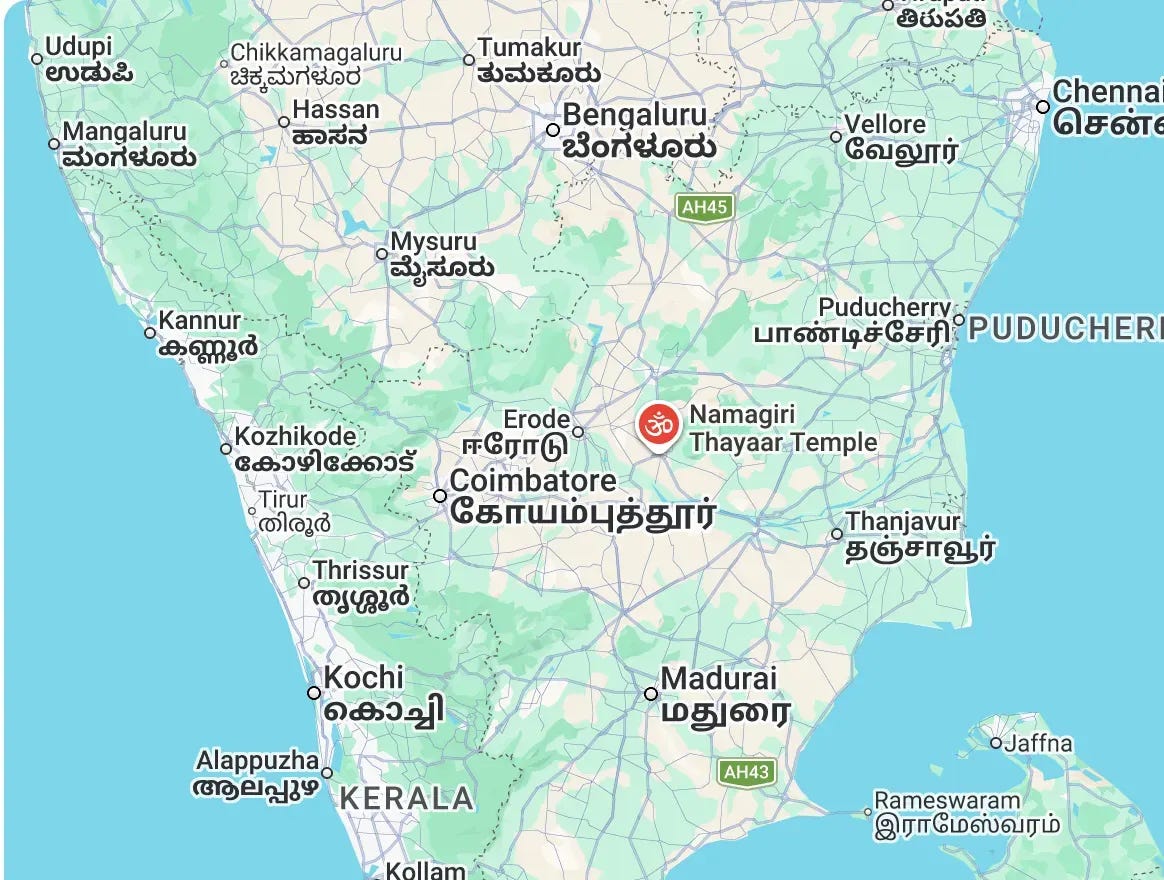
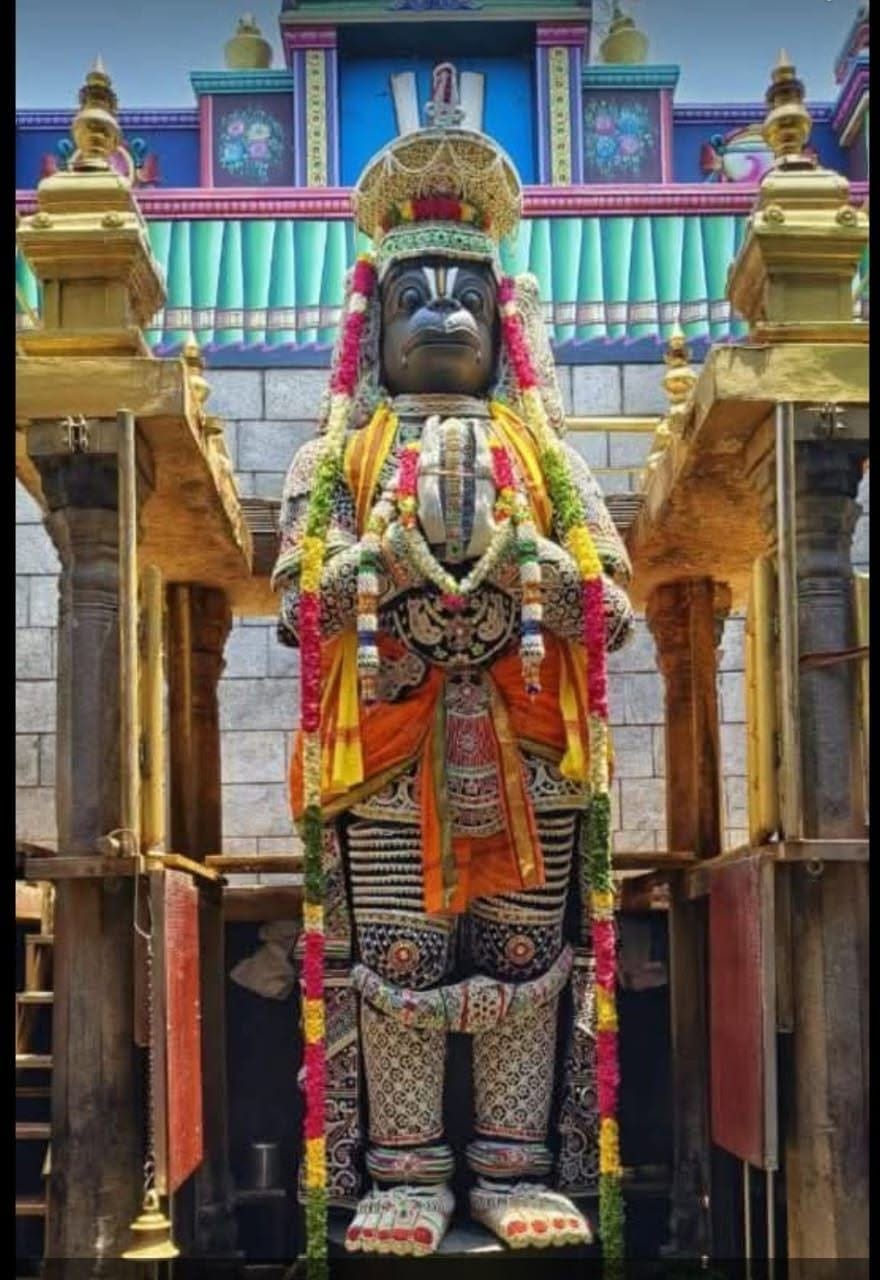
Lets warp-travel into South India, into TamilNadu.
The town of Namakkal. Known for spectacular temples, of Shri Narasimha, Lakshmiji and most famous Hanumanji mandir.
Here, Standing 18 feet high, Shri Namakkal Anjaneya (Hanuman ji) is the tallest arca vigraha of Hanumanji worshipped inside a temple sanctum, anywhere in the world. Every year, thousands of vada malas are offered at this iconic South Indian shrine. Devotees proudly say that Hanumanji has no roof above His head—because He continues to grow taller every day.
Devotees love vishwaroopa anchaneya Hanumanji
But where is he looking at ?
At the lotus feet of Shri ji . This is the town of Namakkal (Holy name - mountain of faith), and where Mata lakshmi is there as Shri ji, Namagiri. thayaar, the mountain also bears same name Namagiri.
The post credits screens from Srimad Ramayana
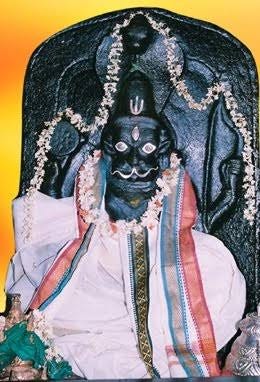
When Lord Vishnu had to rush to appear as shri Narasimha and defeat Hiranyakashipu, he went fast without Gardua or Mata Lakshmiji. Mata Lakshmi missed witnessing his divine appearance from the start of break of pillar, although she arrived much later on to join Shri Narasimha and Prahlada. For she was so eager to see the glorious form of the lord again, and fully from the start, many yugas later sheperformed penance at the banks of the sacred Kamalalayam pushkarni, chanting the Lord’s name :
“Om namo narayanaya”.
“Om namo narayanaya”.
“Om namo narayanaya”.
This was the same time, at the end of the Ramayana, Hanuman ji went to return the Sanjeevani Mountain back at its original location. After doing so, he found a sacred Saligrama stone on the banks of Gandaki River. On his way back, he stopped by at the Kamalalaya Pushkarni to perform his morning prayers. Finding Goddess Lakshmi undertaking penance here, he placed the Saligrama on her hand and went ahead with his prayers. Godess lakshmi put the Saligrama down there, —and by divine will, it could not be moved. The sacred stone blossomed into the holy Namagiri Hill, from which Lord Narasimha appeared to bless Mahalakshmi and His beloved devotee Hanuman.
Just as in Ahobilam’s , where as Karanja Narasimha, the Lord revealed Himself as Shri Rama to Hanuman, Namakkal echoes the timeless truth—Rama and Narasimha are one. Thus, Shri Namagiri Thayar, Lord Narasimha, and Shri Anjaneyar continue to grace this sacred kshetra.
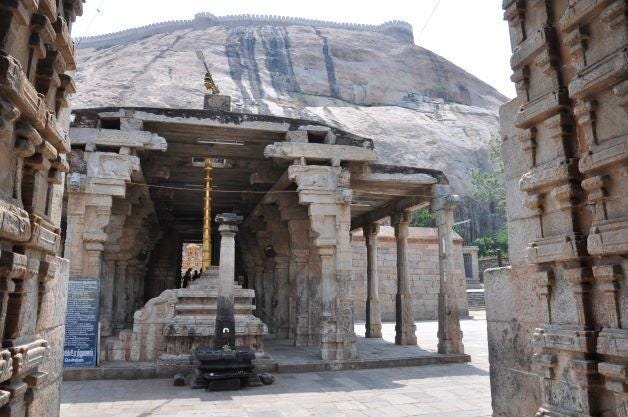
Most glorious Sri Narasimha Sri ji Namagiri Lakshmi mata ji’s temple is most beautiful rock cut architecture and has stood there for devotees.
Namagiri Thaayar, Mata MahaLakshmi, Shri ji
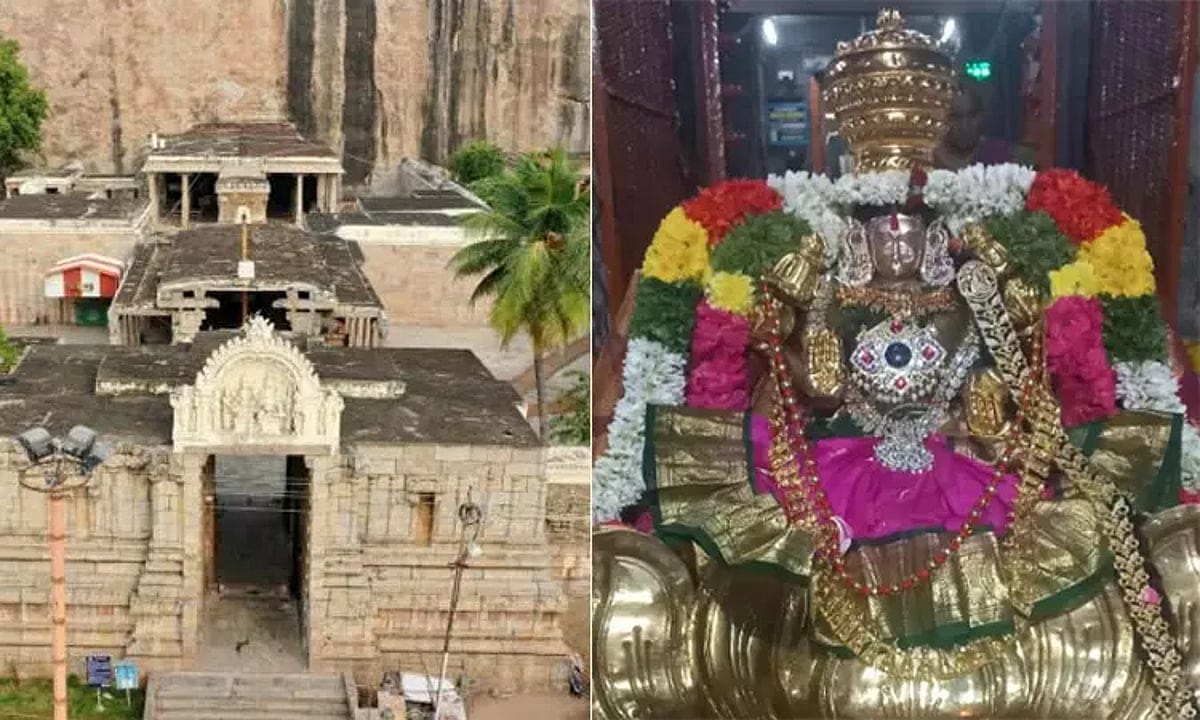
Sri Vidya Mantra Ratna Prakatitha Vibhavaa
Sri Subalaapoorna Kaama, sarveshaprathidhaa
Sakala suranuthaa Sarvasaamraajyathaathri
Lakshmi Sri Veda Garba Vidhurathu Madhiyaa
Viswa kalyana bhooma ,Vishwa Kshemaatham Yoga
Vimala Gunavathi Vishnu Vakshathalasya
The “Mother First” Tradition
One of the most cherished customs at Namakkal is that devotees first offer their prayers to Namagiri Thayar before entering the shrine of Lord Narasimha. This tradition reflects the belief that the Mother’s compassion and grace prepare devotees to receive the powerful darshan of Narasimha.
Many devotees approach Thayar first with their personal prayers, seeking her blessings for protection, family wellbeing, and the fulfilment of their wishes, before proceeding to the Lord’s sannidhi.
Mother First
First Darshan: Devotees visit Mata Namagiri MahaLakshmi first to please Lord Narasimha and obtain his grace.
First Advocate: She acts as the mediator to ensure the Lord accepts the seeker with total grace. She tells “Please forgive the small mistakes of the child”
First in Worship: She Leads Navaratri celebrations ahead of the Lord’s rituals.
First Prasadam: Sacred Thirumanjanam Prasadam is offered to her before any other deity.
First in Scripture: Nammazhwar invoked Lakshmi first (“Agalagillen...”) before surrendering to the Lord.
Why Mother First? — Principle of Purushakaram
In (Sri) Vaishnavism, Purushakaram (divine mediation), explained by Acharya Manavala Mamunigal (through the works of Sri Lokacharya), teaches why devotees approach Mother Lakshmi first before surrendering to Narayana.
Justice and Mercy: Where conflicting angles meet
Svatantryam: Narayana represents divine justice and the law of karma.
Karunyam: He is also infinite compassion and mercy.
Sri Lakshmi bridges both: She approaches the Lord with the devotee’s plea and transforms judgment into grace.
Mother Lakshmi — The Compassionate Mediator
To the soul: She is the loving Mother who removes fear and offers refuge.
To the Lord: She appeals for forgiveness, reminding Him that devotees are His children.
Her presence awakens the Lord’s boundless mercy.
The Dwaya Mantra
“Sriman Narayana Charanam Saranam Prapadye”
Surrender is to Narayana together with Sri.
The tradition of visiting Namagiri Thayar first reflects this belief: the Mother’s grace opens the way to Lord Narasimha’s divine presence.
Shashtra Pramana - Proofs
Rahasyatrayasaram (by Sri Vedanta Desika):
Even across both major sub-sects (Vadakalai and Tenkalai), Sri Vedanta Desika emphasizes Purushakarathvam—that Lakshmi’s innate, eternal nature (Svaroopa) is to turn the Lord’s justice into pure mercy.
Gadhya Trayam (by Sri Ramanujacharya):
In the Saranagati Gadhyam, Acharya Ramanuja himself did not pray directly to Lord Narayana first. He performed Purushakara Prapatti—surrendering first to Goddess Lakshmi to ask for her recommendation, and only after she approved did he turn to surrender to Narayana.
Sri Vachana Bhushanam (by Sri Pillai Lokacharya):
Dedicated entirely to defining Purushakaram. It explicitly states:
“Because the Jiva (soul) is bound by sins, and the Lord is bound by His laws of justice, the union between them cannot happen without the mediator (Purushakaram) — Goddess Lakshmi.”
Absolute - Shastra Pramana
The National Anthem of Vrindavan
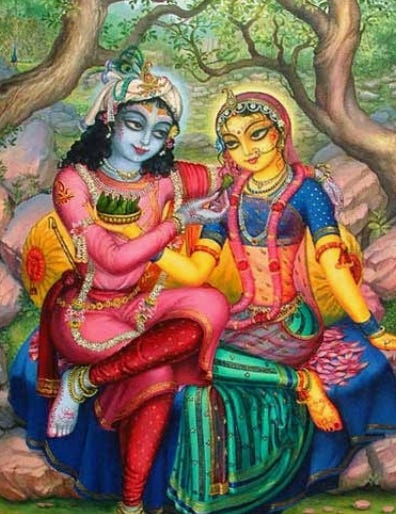
Gaudiya Vaishnava’s explain most beautifully
Krishna is Madana-Mohana (the enchanter of Cupid),
but Radharani is Madana-Mohana-Mohini (the enchanter of Krishna who is the one who enchants Cupid). Therefore, going through Radha guarantees acceptance by Krishna.
Srila Rupa Goswami writes in Radha-Kripa-Kataksha Stava:
Also called the National Anthem of Vrindavan
Devotees pray solely for Radharani’s Kripa-Kataksha (merciful sidelong glance). The belief is that if Radharani casts just one glance toward a fallen soul, Krishna immediately claims that soul as His own.
munīndra-vṛnda-vandite triloka-śoka-hāriṇi
prasanna-vaktra-paṇkaje nikuñja-bhū-vilāsini
vrajendra-bhānu-nandini vrajendra-sūnu-saṅgate
kadā kariṣyasīha māṁ kṛpā-kaṭākṣa-bhājanam
O Radhrani Lakshmi mata, whose delicate feet are as splendid as red blossom flowers, Mata whose hand grants fearlessness, O abode of transcendental opulence's, when will You make me the recipient of Your merciful sidelong glance?”
anaṅga-raṅga-maṅgala-prasaṅga-bhaṅgura-bhruvāṁ
sa-vibhramaṁ sa-sambhramaṁ dṛganta-bāṇa-pātanaiḥ
nirantaraṁ vaśī-kṛta-pratīti-nanda-nandane
kadā kariṣyasīha māṁ kṛpā-kaṭākṣa-bhājanam
“O Mata Radharani who’s glances from the curved bows of your eyebrows has completely subdued Nanda’s son Krishna, when will You make me the recipient of Your merciful sidelong glance?” - mentioned in bhakti bhava by devotees
Hare Krishna Mantra Structure
In age of Kali, as explained by Shri Chaitanya Mahaprabhu who is Swayam Bhagavan Shri Krishna, chanting of the Hare Krishna Mahamanta is the only way to salvation.
harer nāma harer nāma harer nāmaiva kevalam
kalau nāsty eva nāsty eva nāsty eva gatir anyathā
So we chant
Hare Krishna Hare Krishna Krishna Krishna Hare Hare
Hare Rama Hare Rama Rama Rama Hare Hare
Hare here refers to “Energy of Krishna” , refers to Shriji Radharani.
You call upon Hare (Radharani) before Krishna.
You say “O Radharani! O Krishna! Please engage me in Your service. You appeal to the Radharani first to guide you in the spiritual journey.
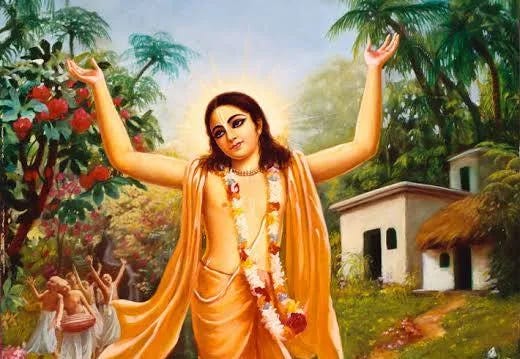
Infact as Sri Chaitanya Mahaprabhu, Krishna appeared in the mood of Radharani, to experience purest devotion and infinite love, of Shri ji Radharani, and he sets an examples for all devotees such, which is the biggest evidence
From Shri Yamunacharya
After establishing the inseparable nature of Śrī and Nārāyaṇa through the Viṣṇu Purāṇa, Bhagavad Yāmunācārya (Srivaishnava sampradaya) deepens this vision in the opening verse of his transcendental Catuḥślokī:
कान्तस्ते पुरुषोत्तमः फणिपतिः शय्यासनं वाहनं
वेदात्मा विहगेश्वरो यवनिका माया जगन्मोहिनी ।
ब्रह्मेशादि सुरव्रजः सदयितस्त्वद्दासदासीगणः
श्रीरित्येव च नाम ते भगवति ब्रूमः कथं त्वां वयम् ॥Kāntas te Puruṣottamaḥ, phaṇipatiḥ śayyāsanaṁ vāhanam,
Vedātmā vihageśvaro yavanikā māyā jaganmohinī;
Brahmeśādi-suravrajaḥ sadayitas tvad-dāsa-dāsī-gaṇaḥ,
Śrīr ity eva ca nāma te Bhagavati, brūmaḥ kathaṁ tvāṁ vayam?
“Puruṣottama is Your beloved. Ādiśeṣa is Your couch, throne and vehicle. Garuḍa, the embodiment of the Vedas, is Your servant. Māyā itself is but Your veil. Brahmā, Śiva and all the devas stand among Your attendants. O Divine Mother! What name can truly describe You? We can only call You ‘Śrī’.”
In just four verses, Yāmunācārya establishes the heart of Sri Vaiṣṇavas: Śrī is eternally inseparable from Nārāyaṇa, and is the universal Mother, the embodiment of boundless compassion, the puruṣakāra who intercedes for every soul, and the unfailing refuge of all who seek the Lord.
Sri Bhashya of Ramanuja
Bhagavad Rāmānuja gave this eternal union its philosophical foundation through the doctrine of Śeṣa–Śeṣi.
All existence belongs to Nārāyaṇa, yet Śrī alone stands nearest to Him, eternally sharing His purpose without ever being separate from Him. She is not merely with him ; she is his energy, His inseparable compassion. One does not approach her apart from the Lord, but as the divine grace through which the Lord becomes accessible.
The Viṣṇu Purāṇa declares that Lakṣmī never exists apart from Viṣṇu. Whenever He incarnates, she incarnates. Whenever He manifests, she manifests. She is eternally established upon His chest, symbolizing their inseparable unity.
Sri Vedanta Desika
Swami Vedānta Deśika’s Śrī Stuti is a profound 25-verse hymn celebrating Mother Mahālakṣmī. Structured around the deep philosophy of Śrīvaiṣṇavism, it highlights Her dual identity as the ultimate embodiment of mercy (Kāruṇya) and Her inseparable divine union with Lord Śrīman Nārāyaṇa.
Here is how these theological principles are captured across the work:
1. The Principle of Inseparable (Apṛthak-Siddhi)
Viṣṇu Vakṣaḥ-Sthala-Sthitā
“She who eternally resides upon the chest of Lord Viṣṇu.”
This expresses the profound vaiṣṇava doctrine of Apṛthak-Siddhi—the inseparable, organic existence of Śrī and Nārāyaṇa. Just as fragrance cannot be separated from the flower or radiance from the sun, Śrī and Nārāyaṇa are eternally one
2. The Doctrine of Intercession (Puruṣakāra)
Śloka 3: The Peak of Mercy (Kāruṇya-sīmā)
This verse directly emphasizes Mata Lakshmi’s crucial role as the Puruṣakāra—the ultimate mediator with the Lord’s mercy:
ājñāṁ devyāḥ katham api ca naḥ pālayed ity adhīnāḥ ...
paśyanty āryāḥ kāpi kāruṇya-sīmām ||
“The wise behold Her as the ultimate, unsurpassable limit of mercy (Kāruṇya-sīmā). Even the divine administrators look to Her, knowing that the Lord obeys Her compassionate will so that souls may be saved.”
Śloka 7: Softening the Lord’s Justice
Vedānta Deśika specifically praises how Her glance transforms Nārāyaṇa’s strict righteousness into forgiving grace:
When the jīva (individual soul) approaches the Lord, burdened by the jiva’s heavy Karma, it is Her continuous presence on His chest (Vakṣaḥ-sthala) that transforms His Svātantrya (absolute sovereignty and justice) into boundless Kāruṇya (compassionate forgiveness).
Śloka 25: Joint Refuge (Dampatyoḥ Kṛpayā)
śreyo-mūrtiṁ śriyaṁ śaraṇyāṁ prapadye kāntaṁ ca tasyāḥ sakala-jagad-īśvaram |
dampatyoḥ kṛpayā yayor prapannāḥ kṛtārthāḥ syuḥ sarvataḥ sarvadā ||
“I seek refuge in Śrī, the embodiment of ultimate good, and in Her beloved, the Lord of all universes. Through the combined grace of this Divine Couple, those who surrender attain complete fulfillment everywhere and at all times.”
Blessing given to famous Mathematician Srinivasa Ramanujan
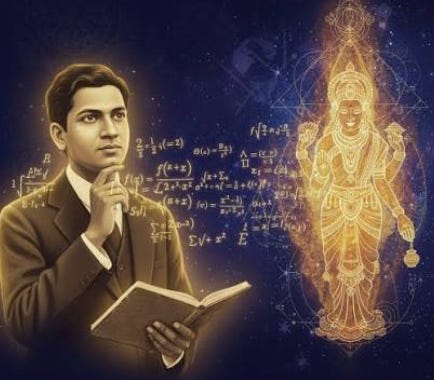
The story of mathematical genius Srinivasa Ramanujan (1887–1920) is one of the most extraordinary intersections of faith and intellect. Ramanujan did not view mathematics as mere logic, but as direct divine revelation from Goddess Namagiri Thāyār of Namakkal—worshipped as Śrī Veda Garbhā, the womb of supreme wisdom.
Born after his mother prayed at the Namakkal temple, Ramanujan possessed no formal advanced training, yet produced thousands of groundbreaking theorems. When asked how he derived complex formulas without step-by-step proofs, he maintained that Mother Namagiri wrote sacred Bījākṣaras on his tongue and projected mathematical equations onto a “red screen” of light before his eyes during dreams.
When invited to Cambridge by G.H. Hardy, Ramanujan hesitated due to orthodox taboos against crossing the ocean. He spent three days sleeping on the Namakkal temple floor until his mother received a vivid vision of the Goddess commanding her to let him fulfill his cosmic destiny.
Ramanujan tied his life’s work directly to divine truth, famously declaring:
“An equation for me has no meaning, unless it expresses a thought of God.”
Uttara Phalguni Nakshatra
(Panguni Uthiram)
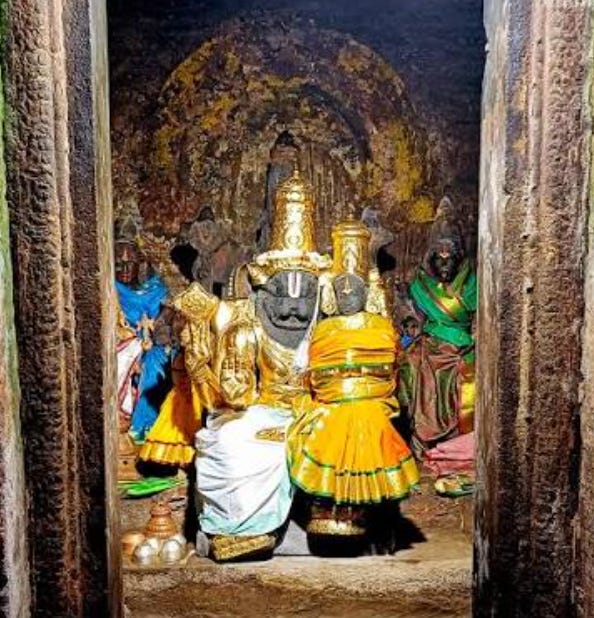
The most awesome time to visit Namakkal is during Panguni Uthiram, known across India as Uttara Phalguni Nakshatra
It falls during the month of Panguni (March–April), when the full moon (Purnima) aligns with the Uthiram (Uttara Phalguni) star. In Vedic tradition, this nakshatra is considered highly auspicious for sacred unions, commitments, prosperity, and harmony.
The day is celebrated as the divine wedding festival of Lord Narayana and Shri MahaLakshmi in Vaishnava traditions. At Namakkal, Panguni Uthiram is celebrated as the sacred occasion of Lord Lakshmi Narasimha Swamy and Namagiri Thayar. The festival includes special abhisheka, alankara (divine decoration), archana, offerings, and grand processions of the utsava murthis (festival deities). Devotees gather in thousands to receive darshan of the divine couple, believing that their blessings bring harmony, prosperity, protection, and auspiciousness to their families.
Conclusion: Mother Shri ji Sri Lakshmi’s Lotus Feet
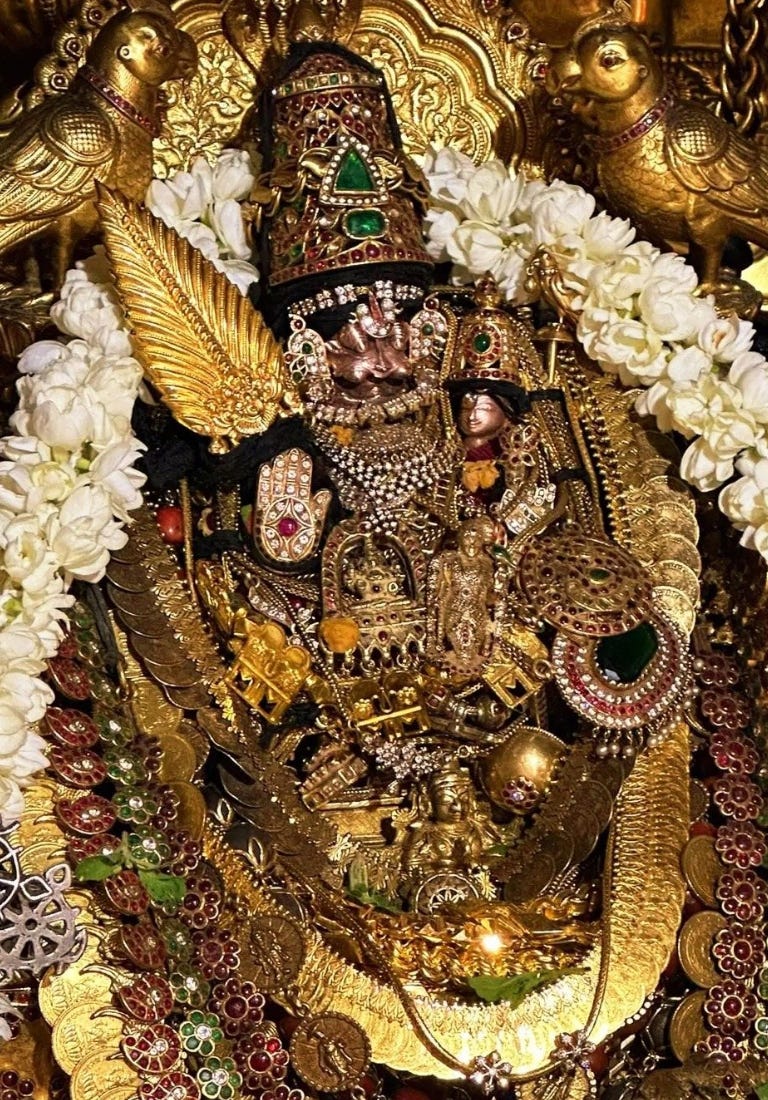
Across every tradition—whether chanting delightedly “Rādhe Rādhe” in Vraja, or following the Āchāryas’ wisdom of Puruṣakāram, or witnessing Ramanujan’s divine insights in Namakkal—one timeless truth shines clear: the direct path to the Lord is through Mother Śrī.
Lord Nārāyaṇa shows absolute justice, but Mother Lakṣmī is mediator for his infinite mercy. Dwelling upon His chest, She transforms into unconditional grace. Even the glorious Śrī Hanuman ji keeps His eyes fixed upon the lotus feet of Śrī Namagiri Thāyār, showing that true devotion begins with surrender to the Mother.
As the sacred star of Panguni Uthiram celebrates the eternal union of Śrī Lakshmi Narasimha Swamy and Namagiri Thāyār, we are reminded that our journey home is already secured. We do not need perfect karma or scholarship; we need only Shri ji’s (Mata Lakshmi’s) grace.
By taking refuge in Her name—as Śrī, Rādhe, and Namagiri—our flaws melt away, and the Supreme Lord lovingly adores us.
Share
This article