Ranga B · 18 May 2026
The roaring proof against Māyāvāda
Introduction Across the Śrī, Madhva, Kumāra, and Gauḍīya sampradāyas, Vaiṣṇava Vedānta arrives at one unified conclusion: the Absolute Truth is Bhagavān—Śrī Kṛṣṇa—eternally personal, conscious, and engaged in loving reci
Share
This article
Introduction
Across the Śrī, Madhva, Kumāra, and Gauḍīya sampradāyas, Vaiṣṇava Vedānta arrives at one unified conclusion: the Absolute Truth is Bhagavān—Śrī Kṛṣṇa—eternally personal, conscious, and engaged in loving reciprocation with His devotees.
Nothing exposes this truth more powerfully than the appearance of Śrī Narasiṁha.
When Prahlāda is challenged—“Where is your God?”—the Lord erupts from the pillar instantly: personal, omnipotent, protective, and fully responsive to bhakti. This single līlā shatters the foundations of Māyāvāda, which claims:
Ultimate reality is formless and without qualities
Individuality is ultimately illusion
Liberation means dissolving into impersonal Brahman
Narasiṁha reveals the opposite. The Absolute is not an impersonal force, but the Supreme Person who acts, wills, protects, and loves.
https://nrsimha.substack.com/p/nrsimham-katha
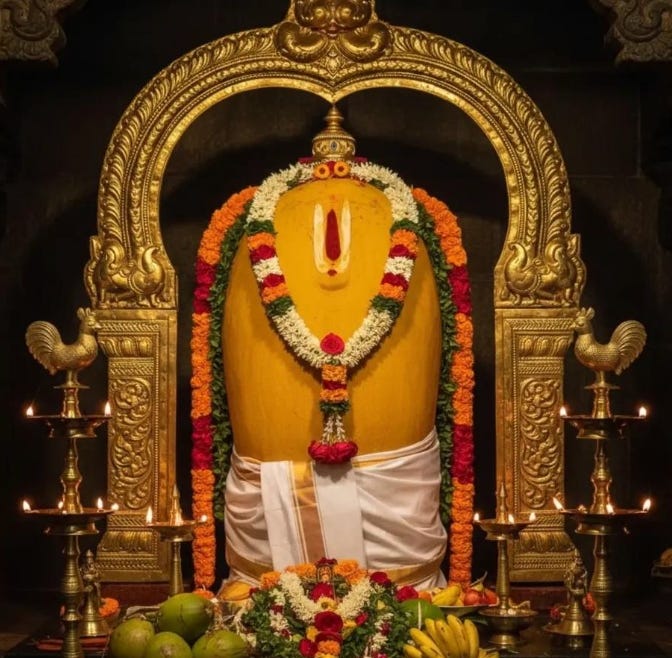
Why Sri Narasiṁha refutes Māyāvāda
Sri Narasimha’s appearance is something Māyāvāda cannot explain, The constructs of logic in mayavada totally fail here
1. Absolute truth is not formless
The Māyāvāda claim that “form implies limitation, therefore ultimate reality must be formless to be all powerful” - Sri Narasiṁha completely overturns this logic.
He manifests from a pillar without material cause—neither man nor lion—yet fully personal and infinitely powerful. He is all-pervading, yet appears locally without becoming confined. His form is not material limitation but transcendental potency.
Māyāvāda fails because it imposes material rules onto the Supreme. But Supreme Lord is not material, he is transcendental. He is antaryami in all creation, yet he is beyond all creation. .Shri Narasiṁha proves he can possess form and remain infinite simultaneously. Thus Māyāvāda logic falls flat.
2. Jīva–Īśvara is a real duality but special
Narasiṁha līlā establishes a clear ontological structure:
There is duality, jiva and isvara are different.
All power belongs to Bhagavān alone. Prahlāda declares that even Hiraṇyakaśipu’s strength and Brahmā’s authority exist only by the will of Nṛsiṁhadeva. Bhagavān is independent; the jīva is eternally dependent.
Bhakti further proves this duality:
Prahlāda prays, Narasiṁha responds. This is real devotee–Lord reciprocation, not symbolism or self-reflection.
If Māyāvāda were true (jīva = Brahman in the ultimate sense), then prayer becomes self-worship, devotion becomes epistemic error, and divine response becomes meaningless—because no real “other” exists. Bhakti narratives would lose all ontological grounding. Yet the Bhāgavata does the opposite: it glorifies Prahlāda as the highest devotee, not someone corrected for ignorance.
However this is a special form of duality: simultaneous oneness and difference. As taught in Viśiṣṭādvaita and Acintya-bhedābheda, the jīva shares spiritual nature with Bhagavān, yet never His infinite supremacy—like a spark from a fire, equal in quality but never in magnitude.
3. Bhagavān is ultimate reality—not impersonal Brahman
Narasiṁha līlā reveals the Absolute as a fully personal, wilful Supreme Lord who acts with intent and purpose. He fulfills Prahlāda’s words, emerges from the pillar without material cause, and exercises moral agency by protecting dharma and destroying adharma. These are not metaphorical gestures. They are real divine actions.
Māyāvāda, however, defines Brahman as attributeless, inactive, and undifferentiated. But an impersonal absolute cannot explain will, love, protection, or purposeful action. It cannot account for the very revelation śāstra presents.
Therefore, since Narasiṁha revelation is direct proof, Bhagavān—who is personal, compassionate, and action-oriented —is ontologically primary. Brahman is only the impersonal effulgence or limited partial abstraction of the Supreme Person.
4. Bhakti is the goal, not merging into God
Māyāvāda defines liberation as merging into Brahman—where individuality disappears and all distinction between jīva and Supreme Lord is erased. The devotee is ultimately dissolved into undifferentiated consciousness, with no real “self” left to love or be loved. How untue!
Narasiṁha–Prahlāda līlā directly contradicts this. At the moment of liberation and divine fulfillment, Prahlāda is not erased but embraced. The relationship is not terminated—it reaches its peak. There is recognition, protection, and blessing, not absorption or loss of identity.
This exposes the core flaw in Māyāvāda: if liberation removes individuality, it also destroys devotion itself. But śāstra does not glorify disappearance—it glorifies eternal bhakti. Therefore liberation is not merging into Brahman, but eternal, special-duality and loving relationship with Bhagavān.
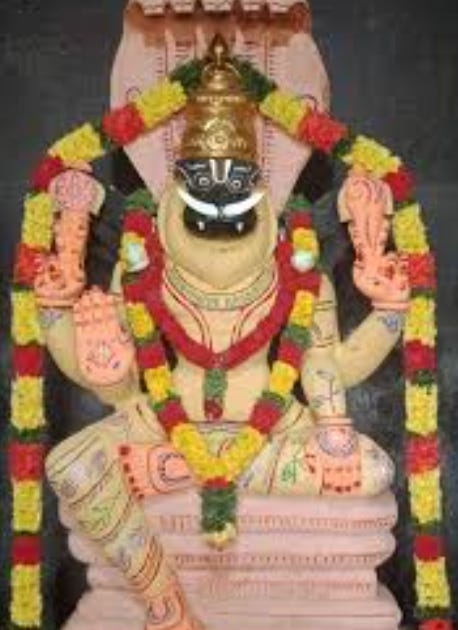
Conclusion
Narasiṁha avatāra establishes the Vaiṣṇava conclusion clearly:
The Absolute has transcendental form
Bhagavān and the jīva are eternally distinct
Bhagavān is supreme over impersonal Brahman
Liberation is eternal loving bhakti, not dissolution
Across Śrī, Madhva, and Gauḍīya sampradāyas, the conclusion is unified:
Narasiṁha does not merely defeat hiranyakasipu
He defeats the insufficiency of impersonal ontology when confronted with loving, deeply personal Lord. Therefore the Vaiṣṇava siddhānta stands:
The Absolute Truth is eternally Bhagavān — personal, conscious, infinite, and realized only through bhakti.
And so we offer gratitude to the Vaiṣṇava ācāryas:
nama oṁ viṣṇu-pādāya kṛṣṇa-preṣṭhāya bhū-tale
śrīmate bhaktivedānta-svāmin iti nāmine
namas te sārasvate deve gaura-vāṇī-pracāriṇe
nirviśeṣa-śūnyavādi-pāścātya-deśa-tāriṇe
Jai Śrī Kṛṣṇa Caitanya Prabhu Nityānanda,
Śrī Advaita Gadādhara Śrīvāsādi Gaura-bhakta-vṛnda.
Hare Krishna!
Share
This article